
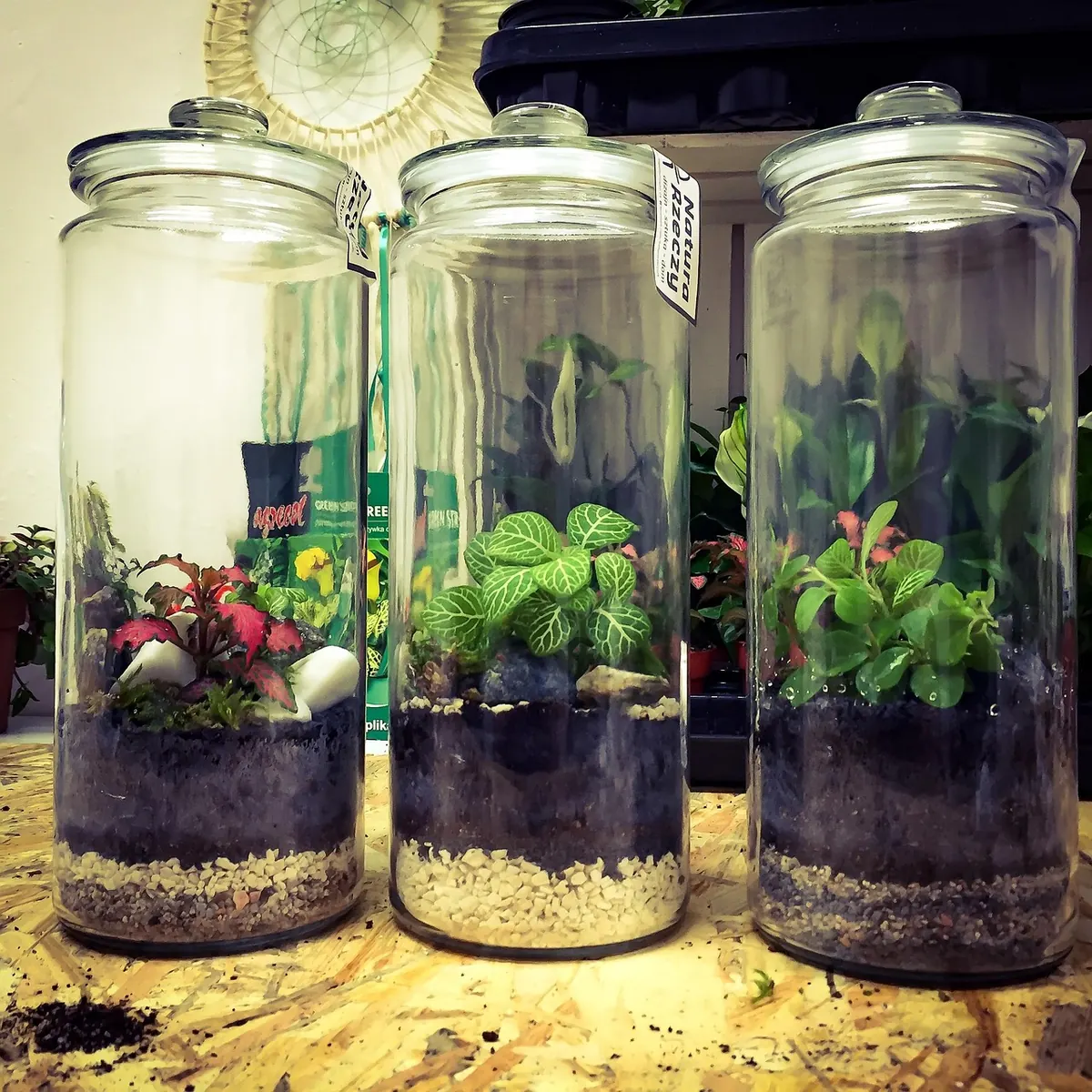
Two jars on the same shelf, both filled with moss, will behave like different planets. Seal one and you create a miniature water cycle: moisture evaporates from the substrate, condenses on the glass and drips back down. Leave the other open and every bit of humidity you add drifts off into the room within hours. Neither approach is better in the abstract. What matters is which one suits your moss, your water and your weekly routine.
The core difference: a sealed loop versus an open one
A closed terrarium is a container with a lid, door or glass plate that sits mostly shut. Because air exchange is limited, water leaves very slowly. You might water it thoroughly at setup and then not again for weeks or months.
An open terrarium has no lid — a glass bowl, a dish, a wide-necked vase, a tray of moss on a windowsill. Air moves freely across the surface, so moisture leaves constantly. You are not creating a cycle; you are topping up a leak.
Both can grow excellent moss. The mistake is treating them as interchangeable, then wondering why the moss in the open bowl crisps at the edges while the closed jar turns to soup.
Humidity and airflow
Moss has no proper roots and no waxy cuticle. It absorbs water across its whole surface and dries out fast when the air around it is dry. Humidity is therefore the single biggest factor in how healthy it looks.
In a closed setup, relative humidity hovers near saturation. That suits most British woodland and bog mosses beautifully: they stay plump, green and cushiony. The trade-off is stagnant air, which is the perfect environment for mould, algae and rot if the glass is never opened.
In an open setup, humidity tracks your room — often somewhere around 40–60% in a heated home, dropping sharply near radiators and in winter. That is dry enough to stress many mosses, but it also keeps mould at bay and makes it much harder to drown the plant.
A middle option deserves a mention: a container with a lid you prop open, or a cloche you lift for an hour a day. You get most of the humidity with a fraction of the stagnation.
Watering: what each one asks of you
This is where the two styles diverge in daily practice.
- Closed: water at setup until the substrate is damp but not dripping, then close it and watch. If condensation fogs the glass so thickly you cannot see through it, open the lid for a few hours. If there is no condensation at all after a day or two, add a small amount of water.
- Open: mist every one to three days in summer, less in a cool room. Aim for damp moss, not wet substrate. A fine mist from 20–30cm away is better than a direct squirt that floods one patch.
- Closed: expect to water a handful of times a year, not weekly.
- Open: expect a routine, and expect to adjust it with the seasons and your heating.
Use rainwater or filtered water where you can. Tap water in hard-water areas leaves a pale crust on moss and glass over time, and Sphagnum in particular dislikes it. If tap water is all you have, let it stand overnight and use it anyway — just watch for mineral build-up.
Common problems, and which setup causes them
Mould and rot
Almost always a closed-terrarium issue. Cause: too much water, too little air movement, or dead plant material left to decay. Fix: open the lid, remove affected moss, wipe the glass and cut back on water. Springtails — tiny harmless creatures sold for terrariums — graze on mould and algae and do a lot of quiet housekeeping.
Crispy brown edges
The open-terrarium signature. Your moss is losing water faster than it can take it in. Move it away from radiators and direct sun, mist more often, and group it with other plants to raise local humidity. If it is already brown and brittle throughout, it is likely dead; trim it back and start again with a fresh patch.
Algae on glass and substrate
Bright light plus constant moisture equals green film. Both setups can get it, but closed ones more so. Reduce light to bright shade rather than direct sun, and clean the glass with a soft cloth.
Matching the setup to the moss
Species matter as much as style. Bog and woodland mosses that grow in damp shade — Sphagnum, fern moss, palm-tree moss, sheet moss — settle into a closed terrarium with little fuss. Mosses from drier, more exposed places, such as many cushion-forming species and Polytrichum, cope better with an open dish and good airflow.
If you are unsure what you have, start open. It is far easier to rescue dry moss by misting than to rescue drowned moss by waiting.
Choosing the right setup for your shelf
Pick closed if you want low maintenance, have a dim corner, forget to water things, and are happy to open a lid occasionally. Pick open if your room is bright but not sunny, if you enjoy a small daily ritual, and if you would rather not risk mould in a sealed space.
A few practical points before you commit:
- Match the container to the moss, not the other way round. A deep bowl for a shallow mat of moss wastes space and traps too much water at the base.
- Use a drainage layer of grit or pebbles under the substrate in both styles, especially closed ones.
- Keep both setups out of direct midday sun. Glass magnifies heat and moss scorches quickly.
- Ventilate a closed terrarium for an hour or two every week or two, even when it looks perfect.
- Give new setups a fortnight of watching before you judge them. Moss recovers slowly and reacts late.
Most people end up with one of each: a sealed jar for the fussy woodland mosses and an open dish for the tough ones. That is a sensible way to learn what your room, your water and your habits will actually support. Whichever you start with, keep the moss damp rather than soaked, keep the light soft, and let the glass tell you what it needs.
Photo: magdakamyszek / Pixabay
Related posts
More stories you’ll love reading